Harvest of What Remains
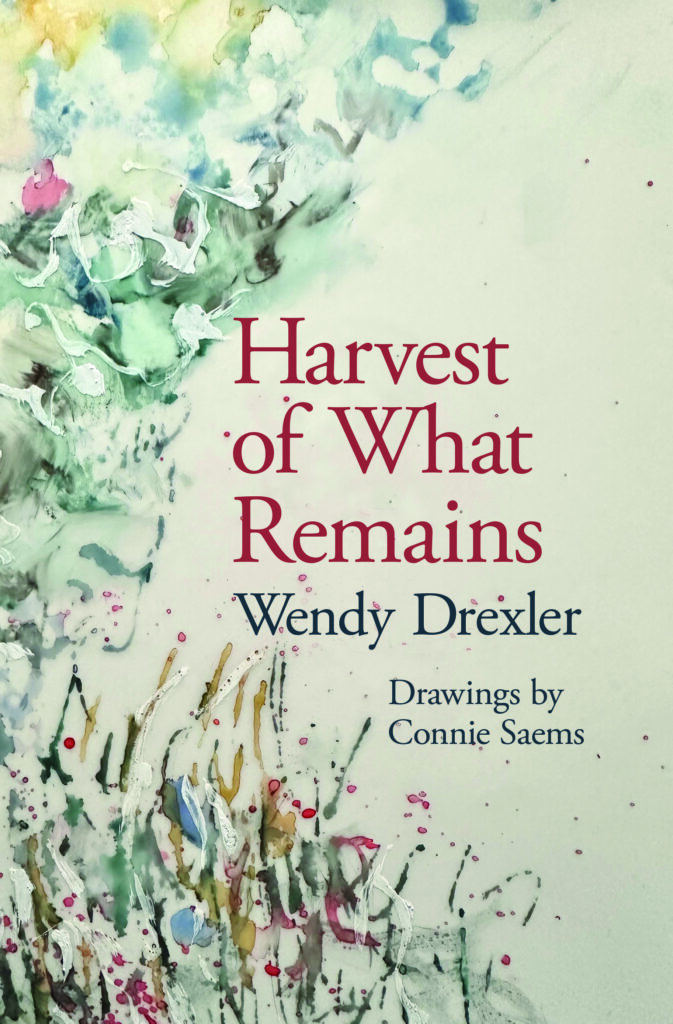 Buy the Book: Lily Poetry Review
Bookshop
Amazon
Barnes & Noble
Published by: Lily Poetry Review
Release Date: February 2, 2026
Pages: 134
ISBN13: 978-1957755687
Overview
In Harvest of What Remains, Wendy Drexler navigates her intense journey as primary caregiver for her husband as Alzheimer’s wraps its great arms around them, irrevocably altering their relationship in ways that call upon depths of grief and survival strategies of dissimulation as well as the imperative to sow seeds of love and compassion. Searching for a form to embody the intense stress and fracture of, at times, nearly unbearable days and nights and the anticipated grief of losing her beloved, Wendy finds guidance and solace in fragments of Sappho by writing into these remains, harvesting new poems and then erasing them the way Alzheimer’s erases the familiar while revealing gleaming shards of insight and consolation.
Praise
"Harvest of What Remains by Wendy Drexler is a brave, intimate immersion into living with and loving someone with Alzheimer's disease. This collection feels raw, heartbreaking, and necessary. 'The Great Arms of Alzheimer's Has Wrapped Us In' serves as a prologue; we know we are in the creative hands of a gifted poet when Drexler speaks directly to the disease. It becomes another character in the relationship. We start in disorientation, a neighborhood of make-believe. Among the richness and density of detail in all the poems, Drexler adeptly makes use of different poetic forms: a sonnet (packed with bitterness of what is plucked and the ripeness of the fallen, how they make a welcome mat of their dying); *an abecedarian (to unveil a tidal wave of twenty-six truths: *If it comes as a mother, it will be a motherfucker. If it comes as a nudist, you will see its bones…); odes (one that add a welcome touch of humor—to a husband's underwear: the briefs, the bands and seams and slices/that holster / your once rapid and dapper,/powerhouse of our pleasure); and a ghazal and duplex that gain power through repetition. Perhaps the most inventive form Drexler utilizes is the reconstructed Sapphic Fragment paired with an erasure. Most sections of the book include one or two. What an inspired metaphor for the loss that haunts dementia. Juxtapositions in poetry are a way of creating engagement, startling our minds into seeing something we hadn't seen before; Drexler links a hot pot restaurant scene to images from the Nature show; she weaves in playing with jacks as she is being helped while parking a car, and a grocery store experience melds with black holes in the universe. This is a braided, knotted arc of chronicling a devastating journey. We feel the speaker's anger, sadness, restraint, and of course, love. A Gerald Manley Hopkins inspired piece ends, The only way to bear this ruthless change: / Loving him."
— Sarah Dickenson Snyder, author of Now These Three Remain
"What's most remarkable about Wendy Drexler's Harvest of What Remains isn't just that it's a thoughtful and technically inventive collection of poems about Alzheimer's disease, but that it's so compassionate and thoroughly—carefully and caringly— observed. These are essentially sad poems, often self-critical, but they're not depressing. By paying such close attention, not only to the actual symptoms of the disease, but also—without understating how difficult that can sometimes be—to how the poet herself comes to learn the most helpful and sympathetic ways to respond to those symptoms, these poems—truly love poems—become extremely life-affirming. This is a book that helps us get better at being human."
—Lloyd Schwartz, author of He Tells His Mother What He's Working On
"This book is a tribute to all caregivers, whose dedication often goes unrecognized. It offers comfort and understanding to anyone who has cared for someone with dementia, or anyone who has witnessed the slow unraveling of memory. It should be obligatory reading for all clinicians working with patients with dementia and their families as a loud and needed reminder of the moving humanity in the privilege of our responsibility. It is a gift to be able to share in this journey through these poems, and I hope readers find the same solace and insight I have."
—Alvaro Pascual-Leone, MD, PhD Professor of Neurology, Harvard Medical School Medical Director, Deanna and Sidney Wolk Center for Memory Health Hebrew SeniorLife, Boston, MA, USA
