Poems
Green Jug
Mother, I’m here with your painted copy of a Cezanne still life
that hangs over the dry sink you bought
with my father years before
I was born.
Every Second Must be the Duration of Something
Begin with light slathering the eel grass
and the horizon, a wide what-if.
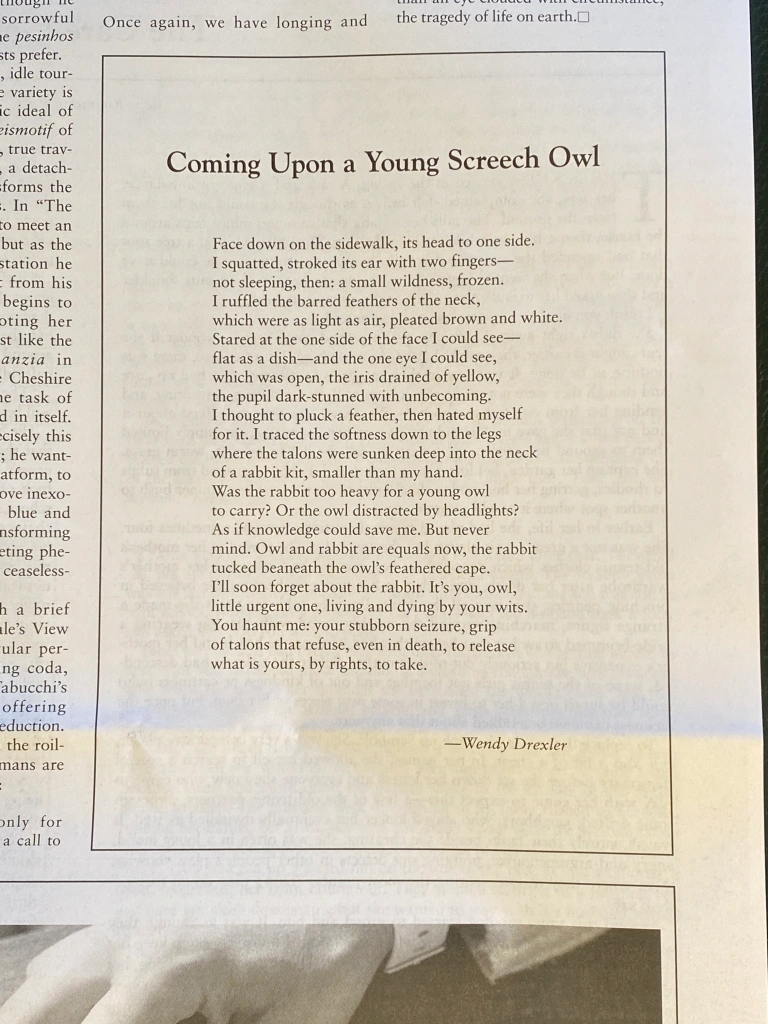
Coming Upon a Young Screech Owl
I’d found a young screech owl on the sidewalk a block from my house, its talons sunk, in death, in the nape of a rabbit kit.
Epoch
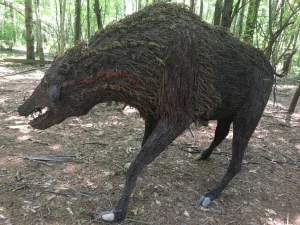
This summer I took part in “Art on the Trails: Unexpected Gestures” at the Beals Preserve in Southborough, MA. Poets were invited to respond to one or more sculptures installed along the trail that meanders through the preserve’s woods, meadows, and pond. My poem “Epoch” was one of two to receive an honorable mention. When I first glimpsed Robert Shanahan’s powerful sculpture “Entelodant” in the woods, adrenalin surged through my body along with the impulse to run from what looked like a giant, very lifelike warthog (on closer examination, artfully made from reeds and brush)! (Entelodant went extinct 65 million years ago.)
EPOCH
The earth collects on all its debts
—Michael Crummey
Beast, with your bronzed fur of reeds and twigs,
your stone teeth, your hooves, stone-cloven,
the stripe of sumac threaded through
your flank. Whorl of your woven ear.
The snarl of you, moving through
the gape of your snout. Bristling
comma of tail where the spider has knit its web.
Entelodont, you are the dark other who makes
the small mammal in me shudder.
You, swept through the Oligocene’s long wake,
peering back, late and strange. We, too,
wear ourselves thin.
When we are as you have become,
who will know us, who will call us
by the hard-washed light of our name?
Moss Muse
CLICK HERE to watch me reading my persona poem, ‘”Moss Muse,” at the opening reception of the Breath and Matterexhibit at Boston Sculptors Gallery, July 18, 2018.
MOSS MUSE
We slid
from inland ponds
and algal strands
once ozone
made it safe
to make our way
to land. But we’re not
primitive, just down
to earth, growing right
under your feet
in girths,
clumps,
fronds,
tufts,
and sheets.
Wise and sly,
we are discrete.
Looking meek,
we crawl
and creep
in the boundary layers,
trapping heat
and water vapor.
And while we’re small,
that’s not all:
we’ve a genius
for filling
the emptiness—
snatching
a scant gap,
spreading
between cracks.
We can haul ourselves
up a wall
with no falderal,
and still leave our mark
on logs, stumps, and bark.
For a lark, some of us
park on the backs
of beetles, wheedling rides.
Everyone stomps
on our backs,
which helps
our rhizoids
latch and attach.
We’ve no need
for seeds or roots,
flowers or fruit.
We adore
opening
our pores,
throwing
our spores
to the wind,
finding rapport
in the shadiest
out-of-the way.
Our sex is
complex:
some sperm
swim to eggs
on a single
splash of water—
but some are
too slow
or get stalled
by the wall
of a water droplet.
So we’ve devised
more ways
to multiply.
Some of us are
celibate, propagate
by cloning
body parts—
bulbils,
brood bodies,
and branchlets
that detatch,
disperse,
immersed
in new habitats.
We have our pets, too,
never neglecting
the welter
of invisible fauna
to whom we give
food and shelter—
sharing our lairs
with cuddly water bears,
a load of rotifers,
springtails
with thin tails,
flowing nematodes,
the delightful mite.
Here’s our secret
to doing without
in times of drought:
dried up and shriveled
we’re not dead,
but dormant.
And before
we shut down,
our genes
will have written
precise
genetic
instructions
for our resurrection.
For we know
the ways of rain,
the art of waiting—
100 years if we must—
unflustered, gathering
dust, packed
tightly together,
holding onto each other,
until water,
our goddess—
bestows just one drop:
in only seconds,
we reckon,
we revive,
photosynthesize,
thriving
on proteins,
restored to life
and to luster,
parading
once more
in the shade,
our stock and trade,
sipping dew,
and rising anew.
— Wendy Drexler, 2018
Probability Theory
Here’s a poem that I’m proud to have published in J Journal, which is affiliated with the John Jay College of Criminal Justice at CUNY.
PROBABILITY THEORY
I’ve been trying to get dressed
in time to take out the recycle bins
but my daughter’s just called
from New York to FaceTime
with my granddaughter
so I’ll definitely let the tins
of cat food sweat it out
with the plastic milk
and humus containers
in their bin on the back porch
just before she called
a climate scientist said on the radio
we have probably 100 years
to prevent total climate catastrophe
and if we had the technology of 100 years ago
with the 7 billion of us alive today
we’d for sure be goners
though if we had the population
of 100 years ago and today’s technology
we’d sail right through
but there’s almost a 50/50 chance
given today’s population
whether today’s technology
can actually save us that’s only
a few generations away
and my granddaughter has no idea
what kind of world she’s been born into
and I don’t want to miss a single glimpse
of her happily stacking and snapping
the interlocking parts of her
Duplo blocks together even though
they’re cheap LEGO® knockoffs
that came in a huge zippered plastic bag
from TJ Maxx by way of China
and there’s probably better than
a 50/50 chance they don’t work
as well as the real thing
Closing the Loop on the Year
Here’s a poem for the waning days of 2017. “Closing the Loop on the Year” first appeared in The Hudson Review. At this time of year, I buy a new desk calendar, even though I now keep a digital calendar as well, and I transfer with colored markers all the birthdays of family members and friends from last year’s calendar to the new one, adding notes for concerts, doctor’s appointments, poetry readings, the dates taxes are due.
CLOSING THE LOOP ON THE YEAR
Snow clings to shingles. I riffle December
pages of my calendar—coffee-stained days,
bills paid, to-dos and past dues,
the late tracery of time spent, nearly
forgotten. I peel
the cellophane from the new calendar, turn
the blank pages. I want another year, oh yes.
And another after that. I want
tenacity like the dogwood outside my window,
preparing to stay, bare branches huddled hard
against the side of the house—
the one shoot that races straight up
from the middle of the crown—
brown umbel with its parasol of stalks,
each stalk capped with a pink bud
ready to be struck into white stars,
on whose account, by May,
the whole branch will tremble.
The Birch
“The Birch,” from Before There Was Before, was first published in The Hudson Review. I remembered that the “little brown dog” was on the back of the slipcase, and that the book was Thomas Mann’s Joseph in Egypt. The dog was actually the logo for Alfred A. Knopf. This was the book! Funny how some memories bob back up while others are unrecoverable.
THE BIRCH
I scramble up the slippery trunk. I’m five,
in my own backyard. I fling my one leg,
then the other, hoist myself into the tree.
Then I crack open the shells
of my sunflower seeds, wiggle out
the kernels with the tip of my tongue,
spit the empty shells down to the grass.
I peel bark the way I want to,
the way I peel my scabs to see
the pink skin, the new part underneath,
just born. I watch
clouds scrub the sky. I stay up here
in my brave room until all the fathers
have walked home from the bus stop after work,
carrying the newspapers under their arms,
the streetlights just coming on.
My father is not coming home. He’s left
my mother and me and all
his shirts and his camel’s hair coat
in the hall closet. All his books
on the shelves, even my favorite
with the little brown dog I love
on the cover, his front and back legs
outstretched, running hard.
First Farmers
I’ve been fascinated with the idea that our ancestors may have been healthier and happier as hunter gatherers than as farmers. In Yuval Noah Harari’s book Sapiens, he makes a good argument for this.
FIRST FARMERS
and everything / Was toil, relentless toil, urged on by need.
—Virgil
It took centuries to domesticate the wild
goat, grow almonds and olives from seed,
harvest barley with stone sickles.
- « Previous
- 1
- 2
- 3
- 4
- Next »
